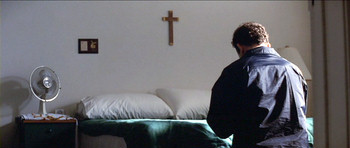
 The first images of Jim Kurring involve his morning routine, and it’s nothing remarkable: He eats, he showers, he reads the paper, he exercises. But there are little hints about how we’re supposed to react to him. He laughs out loud – and not very convincingly – at something on the Today show. When he’s lifting weights, we see one of those inspirational posters encouraging “determination.” And he prays, on his knees at the foot of his bed, with a cross looking down upon him. When he finishes, he gets up and claps his hands together once, as if Team God had just broken from the huddle. We learn through voice-over that he participates in some dating service, or at the least runs a personal ad. He’s a cop, and he gives himself a pep talk in the squad car.

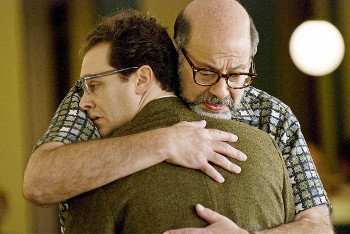 I was surprised after watching (and then reading reviews of) the Coen brothers’ A Serious Man that there was such a fervent (if small) backlash against it. The movie – about a Job-like Jewish professor in a Minnesota suburb in the late 1960s – struck me as so right that I didn’t allow for opposite reactions. Yet there they are.
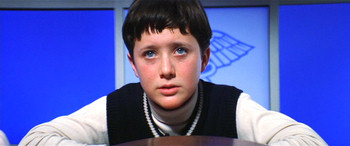 This is what customer service is all about. Seven hours after voting closed in a poll for the next installment, we’ve published the Drunken Commentary Track for Paul Thomas Anderson’s Magnolia – and the movie’s three hours long.
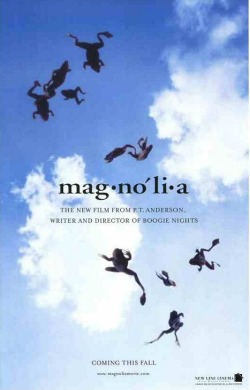 Why does nobody take the frogs seriously? Why does nobody question them? In Paul Thomas Anderson’s Magnolia, the cataclysmic, apocalyptic rain of frogs seems casually accepted. Nobody says: “That’s some fucked-up shit, those frogs.”